For collective bargaining, new rules would include special mediators, early bargaining obligations and a codified Section 107

'A good step in the right direction': What HR needs to know about Bill C-39
For collective bargaining, new rules would include special mediators, early bargaining obligations and a codified Section 107
"I think it's fair to say that these are the most significant changes to the collective bargaining process in Part 1 of the Code in decades," says Chris Pigott, a partner at Fasken in Toronto.
"We're talking since 1999 when the last fundamental changes were made. So, these are definitely something that employers need to be paying attention to."
Pigott is referring to Bill C-39, the Building Canada Strong Act. While much of the bill is aimed at speeding up infrastructure approvals and modernizing ports and trade corridors, Part 3 — titled "Canada Strong for All" — contains a substantial rewrite of Part I of the Canada Labour Code, which governs labour relations.
The proposed changes include a new special mediator process, mandatory early bargaining for parties with a troubled history, first contract arbitration, post-bargaining mediation, and — most contentiously — a revamped Section 107 that sets out when the minister can step in to end a strike or lockout.
In the government's news release announcing the bill, Patty Hajdu, Minister of Jobs and Families, said the legislation "will protect the right to strike while reinforcing the responsibility of unions and employers to negotiate in good faith."
Bill C-39: Why now?
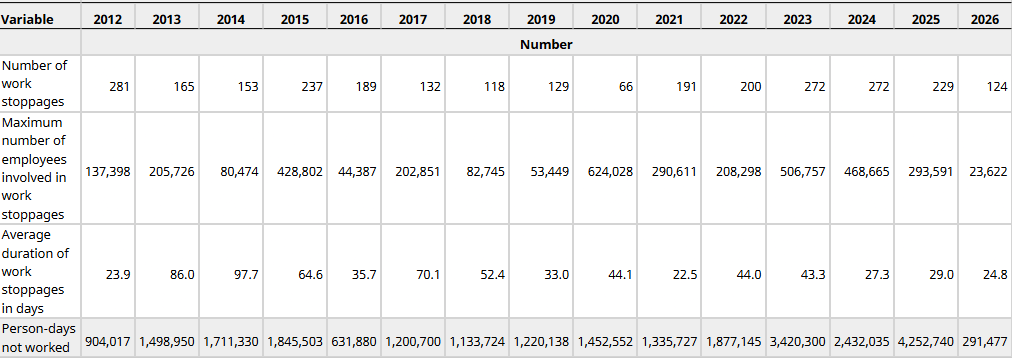
For employers, the changes are largely welcome given the frequency and impact of recent work stoppages in federally regulated sectors like rail, ports and aviation, according to Derrick Hynes, president and CEO of FETCO (Federally Regulated Employers – Transportation and Communications).
"We think we've entered a highly unsettling pattern where work stoppages, particularly in critical supply chain industries, have just become far too common.”
He points to government data on person-days lost to strikes and lockouts, citing higher numbers in recent years.
"We have a problem that needs to be addressed," says Hynes. "We've seen a lot of intervention by government in these processes over the last two to three years. I think there's a better way of doing business."
Ideally, the government will incentivize more successful collective bargaining and parties would still get deals on their own, he says.
“But we do think there may be circumstances where there needs to be some sort of a backstop to avoid the kind of consequential damage that Canadians have been experiencing over these highly impactful work stoppages,” says Hynes.
"We don't think it's perfect. We think it's incomplete. But it’s definitely a good step in the right direction."
Pigott agrees that from the employer perspective, the changes "are definitely needed."
"Over the course of the past few years, there have been a number of situations — major work staoppages that followed lengthy rounds of collective bargaining — where the parties were simply unable to negotiate an agreement," he says, adding the proposed alterations “are hopefully going to put pressure on both sides to negotiate harder and get deals at the table.”
Early bargaining — for some
As part of the proposed changes, a new Section 50.1 would require certain parties to meet and begin bargaining between 200 and 180 days before their collective agreement expires, notify the minister and the Canada Industrial Relations Board (CIRB), and engage with the Federal Mediation and Conciliation Service (FMCS) right away.
The obligation only applies in three situations: where the expiring agreement was the result of an imposed binding method of resolving the dispute, where a strike or lockout occurred during the bargaining that produced it, or where the agreement has a term of five years or more.
Employers would also face a statutory freeze. As of the 200th day before expiry, they could not alter pay or other terms and conditions of employment without the union's consent until the parties are in a legal strike or lockout position.
In theory, these are positive changes, says Pigott.
"They're going to require both employers and unions who have had a difficult bargaining relationship in the past to pay early attention to the upcoming round of collective bargaining and engage with a neutral third party, FMCS, which is very highly regarded in the federal employer community, at least.”
Hynes is supportive but cautious.
"It will help if both parties show up to those early bargaining tables with a genuine interest of engaging in collective bargaining in the early days," he says. "We all know that collective bargaining is often resolved the closer we get to a deadline in practical terms, so there could be situations where it helps. I'm not sure it's a silver bullet solution."
The special mediator
The most novel piece of the bill is a new Division V.01 of the Code creating the role of special mediator.
Under the proposed Section 87.01, the minister may appoint a special mediator at any point up to the 75th day after a conciliation officer, commissioner or board is appointed. The special mediator would have 21 days to try to help the parties settle. If no deal or tentative agreement is reached, the mediator must report to the minister, setting out the issues in dispute, each side's positions, an assessment of how the parties participated, the likelihood of a deal and the mediator's recommendations.
The minister must then share the report with the parties and, after a further five days, make it public. The bill states that the purpose is to ensure a minimum of 10 days between the report's publication and any strike or lockout.
The appointment of a special mediator does not, on its own, suspend the right to strike or lock out.
The public release is the key feature, says Pigott.
"The idea being that if there is public transparency as to the collective bargaining dispute and what the issues are, that that may put some public pressure on the parties to be reasonable in their bargaining positions and try as hard as possible to resolve the dispute.
“That's entirely new. That's a big change, and I think that is pretty generally viewed as a positive change by both employers and unions."
Hynes calls the special mediator the most notable change in the bill.
"Ultimately, we think the best deals are always made between the parties, and bringing in a special mediator with some enhanced authorities could be helpful in that regard," he says. "If it's not, the legislation lays out a process where that special mediator will then issue a report to the minister identifying what's happening at this bargaining table… and recommending a path forward.”
“If that is still unsuccessful, that report could be made public, which we think would be helpful.”
Gerard Di Trolio, a PhD candidate in labour studies at McMaster University, says the timeline seems workable: "When you're trying to settle down or solve a dispute like this, I think 21 days is actually reasonable."
Section 107: intervention only after a stoppage starts
The revised Section 107 is where the bill is likely to draw the most scrutiny from both sides.
Under the proposed wording, if a legal strike or lockout occurs, the minister could direct the CIRB to order a return to work, extend the collective agreement or impose binding arbitration — but only if the minister has considered the special mediator's report and is of the opinion that the stoppage "adversely affects or may adversely affect the national interest."
The revamped Section 107 is “very much needed,” says Pigott.
“These amendments, if enacted, should put to bed this legal dispute over whether or not Section 107 does in fact give the Minister of Labour the right to intervene in a work stoppage, which is currently the subject of a number of lawsuits,” he says. "The courts have said very clearly that doing that can be constitutional in the right circumstances, so we don't see a constitutional or Charter issue under these proposals."
However, the requirement that a strike or lockout must occur before intervening is a change that many employers do not like, says Pigott.
“I think they rightly say, ‘Well, if a strike… or lockout is going to cause damage to the national interest, why do we need to wait for that work stoppage to actually occur and the damage to be done?’"
Hynes calls this proposed change "a huge problem," and says FETCO argued during consultations that, in rare cases where the special mediator's report shows a deal is unlikely and the national interest is at risk, the minister should be able to act preemptively.
"Before a major railway can take a strike, it needs 10 days’ advance notice to wind down the network, to get dangerous goods off the tracks, etc., etc.," he says. "So if, for example, under the current bill, this minister allows a one-hour strike and then decides to intervene, what that means in practical terms is that railway will shut down 10 days before that strike date, the strike will occur, the minister may intervene and order workers back to work, and then it will take weeks to ramp that operation back up again."
While certain groups have expressed concern about the minister's level of intervention and how it is somehow taking away the right to strike, Hynes says, “what we are talking about here is very rare circumstances to be used in only an exceptional way."
‘Questionable implications’ with Section 107
Di Trolio says the changes are not revolutionary but about the government trying "to better codify Section 107,” in making it more procedural and “trying to protect it from a Charter challenge."
“I think it makes sense for them to [put] better framing around this, but there are still some questionable implications from it.”
He notes that Section 107 sat largely unused for years before its use accelerated recently, and says that making intervention more predictable may discourage genuine bargaining.
"If one side is incentivized just to wait for the government to intervene… that's just going to deter bargaining in good faith… it basically creates no penalization for bargaining in bad faith," he says. "And from an employer and HR perspective, if you're going to rely on a government-imposed arbitration every several years, it's just going to poison the well… every time the contract expires."
Asked whether requiring a stoppage to begin first could lead to longer strikes, Di Trolio says he's not sure — but points to union reaction. He says CUPE's National Executive Council passed a motion saying members will not return to work if a strike is sent to arbitration under the new method.
"If the unions are already pre-emptively declaring that they're going to disobey the law, then yes, it is going to prolong strikes," he says.
Defining the 'national interest'
When it comes to the “national interest,” the bill lists three considerations the minister may weigh: whether the stoppage has or may have a significant impact on the Canadian economy, whether it is causing or may cause serious social disruption, and whether the minister's direction to the board has any impact on freedom of association.
Pigott says this is an area where “we’re going to see some controversy” but adds the test drafted in the proposed legislation is "quite clear," while still leaving room to manoeuvre.
"Those three factors are not exhaustive. The minister is allowed to take into account any other relevant considerations that he or she deems important," he says. "So, the minister of labour does retain flexibility if a different type of situation arises to still invoke Section 107."
FETCO agrees the bar should be high, says Hynes: "This should only allow for government intervention when truly the national public interest is at risk and Canadians are going to pay an unfair price for a work stoppage.”
For Di Trolio, the definition will ultimately be contested at the bargaining table itself.
"How this plays out is going to be competing visions of what the national interest is and who needs to make sacrifices at this time of economic difficulties," he says.
First contract arbitration
A revised Section 80 would also allow either party to apply to the CIRB for binding arbitration if no first collective agreement has been reached within nine months of notice to bargain. The board would be required to order it, and the order would suspend the right to strike or lock out. The parties could still reach their own deal before a binding determination is made.
Pigott says the nine-month timeline is reasonable, but the mechanism raises concerns for employers.
"It's not so much the time limit that is concerning to employers, as the fact that the ability for a party to unilaterally submit a first agreement negotiation to interest arbitration may be misused in some cases by unions," he says. At the same time, he acknowledges "there is also an acceptance that, in some cases, it is hard for both parties to negotiate a first collective agreement."
Di Trolio says unions will likely be more receptive to arbitration in this context "because getting that first contract can be very tricky."
Mediation after the deal
Under a new Section 105.1, where a collective agreement results from imposed binding arbitration or follows a strike or lockout, the minister must appoint a mediator within six months of the agreement to help the parties improve their relationship, and the parties must meet with that mediator.
"I think the big question with that change is ‘Will it be useful in practice? Will parties take it seriously?’" says Pigott.
"Will the mediator be able to make progress in resolving any lingering issues that do exist in the relationship when there isn't the pressure of a collective bargaining negotiation happening?"
Di Trolio calls it "better than nothing," but notes that “bad blood” from an imposed contract can outlast the timeline: “So, it’s something, but it's no guarantee."