Six years after more than 950 workers at High River meat plant tested positive, and 2 died, investigation says OHS regulator 'all but abdicated its mandate'
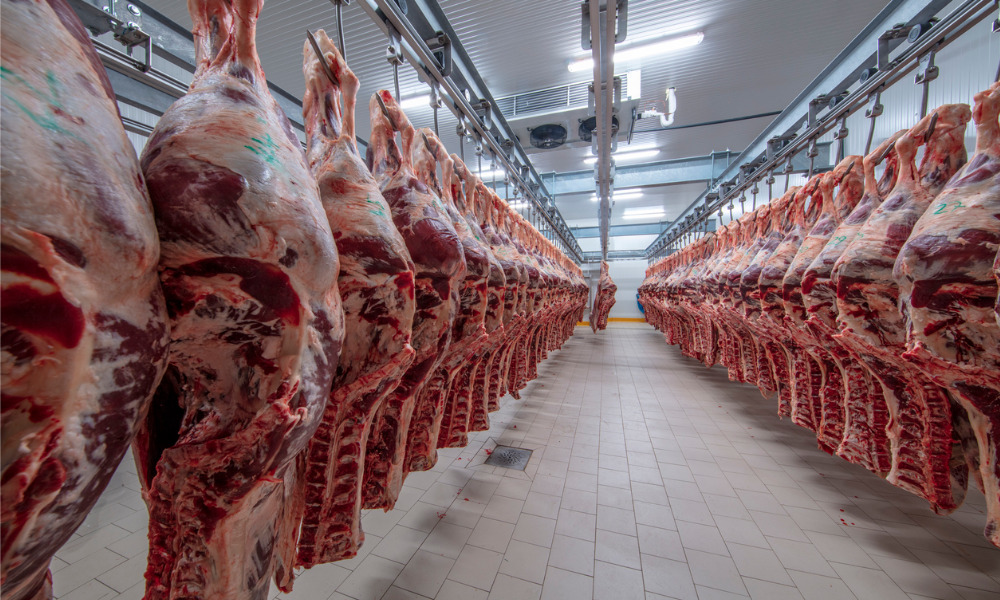
Alberta's occupational health and safety regulator and its public health agency both failed to use their enforcement powers as COVID-19 tore through Cargill's beef processing plant in High River in 2020, according to a new report from the Parkland Institute at the University of Alberta.
The report, Essential and Expendable: How Alberta's COVID-19 Response Failed Cargill Workers, is described by the institute as the first independent investigation into the outbreak. It draws on hundreds of pages of records obtained through freedom-of-information requests, along with publicly available documents and select interviews.
Between April and mid-May 2020, more than 950 Cargill workers — almost 45 per cent of the plant's workforce — tested positive for COVID-19, according to the report. Eighteen workers were hospitalized and eight required ICU care. Two workers died: Bui Thi Hiep, 67, a 23-year Cargill employee, and Benito Quesada, 51, a father of four and union shop steward. More than 650 close contacts of Cargill workers also tested positive; 25 were hospitalized and four died.
"In 2020, both lost their lives to COVID-19 and, ultimately, to Alberta's catastrophic failure to place worker safety above industry interests," the report read.
At the time, it was the largest industrial COVID-19 outbreak in North America.
"There was nothing inevitable about the scale of the outbreak," said Sean Tucker, the report's lead author and a professor of occupational health and safety at the University of Regina.
A regulator on the sidelines
The report argues that Alberta OHS, which held primary jurisdiction over worker safety at the plant, effectively deferred to Alberta Health Services (AHS), even though then-labour minister Jason Copping never delegated his ministry's responsibility for OHS to AHS or any other body.
The only formal in-person inspection by either agency before Cargill idled the plant on April 20, 2020, was an AHS visit on April 7, conducted at Cargill's invitation, which produced non-binding recommendations, according to the report.
On April 15, an OHS officer carried out what the report describes as a 30-minute "virtual inspection" in response to a demand from United Food and Commercial Workers (UFCW) Local 401. The inspection was recorded on a Cargill manager's phone, was conducted without a trained industrial hygienist, and did not include direct conversations with frontline workers. It resulted in no compliance orders, even though several hundred workers were ill, the report says.
The authors call that decision one that "seriously undermined the integrity of that inspection and the independence of the ministry's work."
The report also notes that OHS inspectors wore N95 masks during their May 4 inspection of the reopened plant, the day after Copping approved a ministerial order recognizing KN95 and equivalent respirators. Yet the inspection report recorded that workers were being handed surgical masks at the entrance, and no order was issued requiring Cargill to provide respirators.
"We are trying to prevent shutdowns"
According to the report, AHS made recommendations to Cargill without verifying they were followed and assumed the company had fully implemented them. Internal emails show AHS officials were aware that sick workers were being drawn into work by Cargill's attendance incentives — a one-time $500 bonus and a $2 hourly wage increase — but no directive was issued to stop them.
"They understood the impact this had on transmission of the virus in the plant," Tucker said, "but still didn't issue a directive to Cargill to stop the incentives."
The report cites an AHS official's email to Cargill management stating, "We are trying to prevent shutdowns." When another AHS manager raised the possibility internally that "drastic" measures might be needed, no action followed, the authors write.
A member of AHS's Cargill task force — identified in the report's endnotes as Dr. Annalee Coakley — told the authors: "Medical officers of Health are not in the business of shutting down businesses, especially powerful businesses like Cargill."
Sarah Nunn, an AHS environmental public health manager who acted as the agency's early lead on Cargill, is quoted in an AHS internal lessons-learned document as saying, "By the time we got to the first inspection, we'd already lost the battle."
Essential services designation had "no basis in law"
The report says the Ministry of Agriculture and Forestry, which had no mandate over worker health and safety, played a central role in shaping the government's response around keeping the plant operating.
Industry lobby groups told their members in March 2020 that then-agriculture minister Devin Dreeshen had given assurances the agriculture industry would be considered an essential service. A formal designation followed, which the authors say had no legal basis but effectively exempted meat-packing plants from regulator-ordered temporary closure.
At a joint Cargill and provincial government telephone town hall on April 18, 2020 — offered only in English, with no translation — Dreeshen cautioned workers not to "get distracted by misleading noise or inflammatory rhetoric" and assured them the plant was safe, according to the report. The next day, Bui Thi Hiep died.
Copping told workers at the same event that his department would "continue to conduct inspections when complaints are made," but did not remind them of their right to refuse dangerous work or mention the enforcement tools available to his inspectors, the report says.
An internal government communications document prepared later that month stated: "The Cargill plant is completely safe from an OHS and AHS perspective."
Blaming households, without the data
The report finds that systemic discrimination shaped AHS's understanding of where the virus was spreading. Then-chief medical officer of health Dr. Deena Hinshaw and senior medical officers publicly attributed the spread to crowded households and carpooling among the largely immigrant workforce.
A record obtained through freedom of information shows no epidemiological analysis had been conducted by AHS at that point, according to the Parkland Institute. Hours after the April 18 town hall, Hinshaw asked officials to determine what share of cases came from workplace, carpool, household and community transmission.
An AHS outbreak file from June 2020, which was never made public, later acknowledged that "asymptomatic infection, lack of masks at critical time periods, high-humidity-high-traffic areas, and working while symptomatic likely contributed to increased transmission." The report also notes that 18 of approximately 35 federal food inspectors working at the plant tested positive — workers who were less dependent on carpooling.
Workers told journalists at the time that they felt scapegoated, and the report documents cases of workers being evicted from rental housing because they worked at Cargill.
No inquiry, no charges
In May 2020, then-premier Jason Kenney promised a review of the Cargill outbreak as part of a broader examination of the pandemic response. Neither the government's pandemic review panel reports nor AHS's 244-page internal review of its pandemic response mentioned the Cargill outbreak, according to the report.
No charges were laid under occupational health and safety law, and an RCMP criminal investigation launched after a complaint from Quesada's daughter did not result in charges, the authors write.
The authors note that the OHS department of the Ministry of Jobs, Economy and Trade declined to participate in an interview, and that AHS and the Ministry of Agriculture and Forestry did not acknowledge interview invitations. In response to three freedom-of-information requests to the Ministry of Labour, the researchers say they received a single page.
UFCW Local 401 president Thomas Hesse, who told the authors he exchanged calls and texts with Copping during the outbreak, described the minister's response as "a failure to show courage. A failure to show leadership."
Implications beyond Cargill
Report co-author Jason Foster, a professor of human resources and labour relations at Athabasca University and director of the Parkland Institute, said the problems identified are systemic.
"The shortcomings we identified in our report are built into Alberta's regulatory enforcement system," Foster said. "They potentially impact hundreds of thousands of workers across the province. We need to see the Cargill outbreak as the moment that laid bare these failures—and we need to learn from it."
The report makes 36 recommendations. The five main recommendations call for:
- a public apology from AHS, OHS and the Government of Alberta to Cargill's workers and their families
- adoption of the precautionary principle by health agencies and OHS when responding to new respiratory illnesses
- amendments to the Public Health Act and Occupational Health and Safety Act making clear that OHS continues to lead the workplace response during a public emergency
- a comprehensive review by the provincial auditor of OHS's internal processes, policies and practices, including the staffing of industrial hygiene positions
- a standing list of essential services created through the Alberta Labour Relations Board, with the stipulation that an essential designation must not reduce workers' OHS rights
Other recommendations include requiring that inspections of suspected workplace transmission of a respiratory virus be led by a certified industrial hygienist, ensuring translators are accessible so officials can speak with workers in their first language, using enforcement tools when pay or bonus schemes encourage sick employees to work, and implementing paid sick days during a pandemic.
The authors note that because of the province's ongoing reorganization of its health system, they could not name the specific health agencies that will ultimately be responsible for acting on the recommendations.